Most countries will never have frontier AI. They’re the ones who should be worrying.
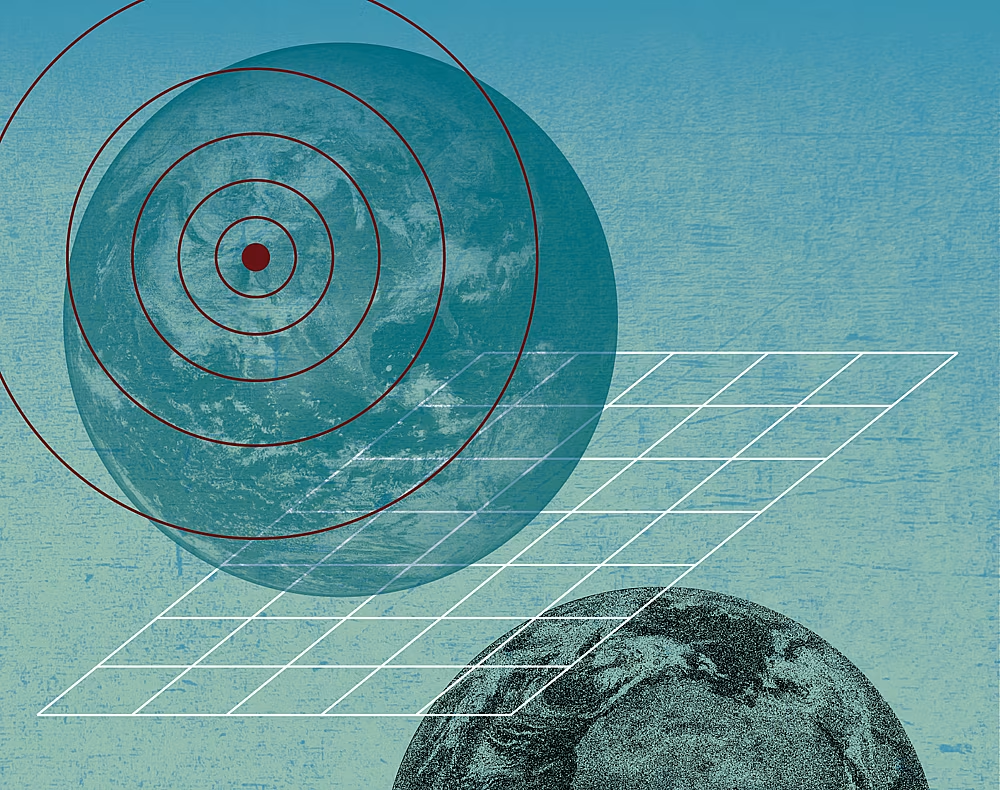
Fear of AI disruption spreads in concentric circles. Outright frenzy inside the labs becomes intense distress in San Francisco becomes palpable anxiety on the East Coast — and once the sentiment has crossed an ocean, there’s only mild discomfort left when it washes upon the shores of the other side.
An honest appraisal of the situation, however, should suggest the opposite response: It’s the employees of the labs, rich in equity and embedded in the most dynamic labor market there ever was, that should feel the least apprehension. Though the institutions of American government face much more immediate disruptions, it is the periphery of AI development — the other 193 countries in the world without a domestic frontier AI developer to tax and regulate — that confront the biggest risks to their economic welfare and physical security.
These risks aren’t resolved even if the AI built in San Francisco is particularly safe or particularly aligned. In fact, the risk may cut the other way: The better AI goes for its makers and their country, the more it threatens to disrupt the countries that build no frontier AI themselves. If their institutions, from labor markets to governments, are unprepared for the coming transition, their citizens risk being consigned to lasting irrelevance. They face life on the permanent periphery of a new world.
The other 193 countries
If you’re reading this magazine, you too have probably been haunted by the specter of the “permanent underclass.” The San Francisco Bay Area is abuzz with concerns that AI will irreversibly calcify a stratified economic order.
Their concern trades on a fairly specific set of premises: AI progress will continue unabated, and perhaps even accelerate. The American frontier developers that reap most of the ensuing economic gains. And the end point of this progress will be a radical transformation, where AI comes to dominate economic affairs and strategic statecraft and power accumulates for those able to deploy the best AI most effectively.
The rest of this piece accepts these premises — and makes the case that, if they are true, they imperil every nation without its own frontier AI. With vanishingly little economic and political leverage compared to AI powerhouses, these countries may permanently lose the ability to compete in global financial and political marketplaces. Rather than existing economic groups within nations being pushed into a permanent underclass, entire countries could be pushed to the periphery.
From the innermost circle of AI development, it’s easy to be distracted by concerns that seem to imperil even in-the-know researchers and operators. But luckily, even under the above conditions, the real world might be a fair bit more complicated than these predictions assume. As the speculative post-AGI economy emerges from the very real constraints of our current political order, there are a few backstops that seem to make the emergence of a permanent underclass less likely.
The first is that the would-be-underclass still wields considerable political power today. The U.S. government holds great power over the trajectory — and even the possibility — of AI development. It could tax or expropriate leading research labs, suppress automation by fiat, or even follow the guidance of the most radical voices and declare the Butlerian Jihad on artificial intelligence, shutting it all down. In the interest of preventing this outcome, technology firms and moderate policymakers will probably do their very best to assuage concerns through policy intervention.
The second backstop is that the economics of AI labor replacement are far from settled science. Though some economists predict widespread disempowerment, just as much evidence points the way of a rearrangement of the labor market instead. The industrial revolution produced machines capable of performing much of what humans used to call work, but we still have not run out of work to do. And even if AI does cause massive labor disruptions, Americans could still stand to benefit — further showing that a permanent American underclass is unlikely to emerge.
None of these factors on their own are certain, and both are subject to counterarguments. The more nuanced takeaway is this: Many of those most worried about social stratification and outright disempowerment from AI might be among the ones most protected from it.
Abdication from the world stage
Most of the backstops protecting Americans are distinctly domestic in scope. The electorate that wields indirect power over these decisions is American. The tax base that swells with AI revenues and enables wealth redistribution is American. And the arguments that labor disruption will be gentle are strongest in the context of one well-connected domestic economy where there are few trade or migration barriers. Even if their careers are disrupted, American workers will be best positioned to use AI systems for their own benefit, since their government ultimately oversees where the American developers allocate their tokens.
Until recently, frontier AI has flowed mostly unrestricted to whichever customers can pay. But U.S. developers and the government that regulates them have plenty of incentives to restrict the market. AI labs and policymakers face three pressures at once: risks of model distillation, threats of misuse, and a potential shortage of tokens. The answer to all three of concerns is to play favorites: Grant API access only to trusted buyers, give frontier access only to known safe customers, and allocate tokens to American buyers first.
This April, the threat of unrestricted access became a lot less theoretical. When Anthropic announced its limited release of Claude Mythos 5 through Project Glasswing, the initial whitelist included no firms or governments outside the U.S. And when Anthropic informed the U.S. government that it intended to expand access, Washington intervened, citing concerns around compute constraints and security. Soon after the Mythos debacle, OpenAI followed suit through a limited release of Daybreak, its frontier cybersecurity model. Shortly after, a fight around U.S. executive action broke out, ultimately resulting in an executive order providing the U.S. government with exclusive access to frontier models for up to 30 days prior to public release. And soon thereafter, the Trump administration used export control authorities to settle a cybersecurity-related dispute with Anthropic, effectively cutting off global access to the industry-leading Claude Fable 5.
In late May, a small handful of U.S. firms officially had a two-month head start in the use of the most capable AI model. It is reasonable to assume that future models could come with at least the same sort of delays. Right now, U.S. firms and agencies have reportedly only used that advantage to become more resilient to the wave of AI-enabled cyberattacks — though according to initial media reports, the NSA might have already started using Mythos to carry out cyberoffensive action while adversaries still don’t have access. As the next step of frontier models enable more and more economically valuable actions — efficiency gains, plucking low-hanging fruit in R&D, corporate espionage, production optimisation, and so on — the effects of a permanent two-month lag could quickly compound.
These concerns assume that frontier AI will retain a distinct advantage over other systems, even those lagging just a few months behind. To what extent this is true remains to be seen. But I believe two trends should make us seriously consider the idea that the frontier matters greatly.
The first is the instability of the fast-follower business model. Procuring the necessary compute to train and run advanced models at scale is becoming more and more expensive, and the capitalization of fast-following firms and their resulting access to chips is quickly falling further and further behind the frontier champions. Perhaps in an attempt to close that gap, Chinese firms seem to be abandoning their commitment to open-source provision of their models, further endangering the fast-follower strategy of relying on the availability of near-frontier models. But closed or not, while fast-following might have been possible under a slight compute disadvantage, it could prove much more difficult once the compute gaps open up further.
The second trend in favor of frontier dominance is the prevalence of zero-sum dynamics in economic and strategic competition. In cases like cyberoffense and defence, financial trading, or services provision at scale, there might be essentially unmitigated competition between AI models themselves. In domains like these, there might be no absolute threshold of “good enough” — the floor is determined by the strength of the adversary’s AI.
All this means that any country that does not develop its own frontier AI may capture the risks while failing to reap the benefits. They capture the risk because every country in the world is exposed to AI’s disruptive impacts, even when the tools themselves are deployed overseas. Criminals everywhere can be empowered by AI, and economic effects do not halt at borders — AI integrators will produce products more cheaply and exert downward pressure on every exporting manufacturer, local service economies will have to start competing with cheaper AI-based solutions, and so on. AI does not need to come to your country to disrupt your life; it’s enough for it to reach your rivals and adversaries.
A country without frontier AI may not secure its benefits because the positive impacts of AI do not necessarily accrue to all countries by default. If countries miscalibrate their policy responses, then new ideas, jobs, and products will not flow evenly to consumers and employees all around the world. If some countries secure unfettered access to frontier AI, it is their demand signal that will shape what products are available on the global market. The spillover effects from the new technology would be imperfectly distributed at best. They could still improve the lives of people on the periphery. But in relative terms, it would exacerbate a gap — at first in individuals’ wealth and welfare, and eventually in nations’ access to the economic inputs required for leverage and power.
Why a periphery and not simply an underclass? The economies in question are still productive, with a workforce and industrial capacity more than capable of sustaining modern life. In an absolute sense, viewed from today’s vantage point, the societies at the periphery do well. They grow toward abundance, leisure, and health at the world’s post-industrial-revolution pace — just not as fast as the frontier of artificial intelligence.
This outcome might seem strangely acceptable at first. But I contend that that is mostly due to a failure of imagination about how wild and extraordinary life at the center of the AI revolution could be. Lucid observers predict that it will end up with humans soon reaching for the stars, spaceships above and nanotechnologies below, the promises of last century’s science fiction fulfilled all within the 21st century. All that would happen without the involvement of those at the periphery. They wouldn’t benefit, and they wouldn’t get a say.
Committing to this path also represents a near-permanent abdication from the actual world stage, and submission to hegemons-in-waiting: A country on the periphery is unlikely to have the military or industrial capacity to mount much relative power, leaving them subject to the whims and wishes of the powerful.
The temptation of self-sufficiency
The challenge, then, is to chart a course through a world where others build the technology that underpins your own economy and institutions. The “middle powers” of the world face a distinct version of this challenge: They have advanced economies to lose, but still a lot of assets to deploy to avert that fate. And while low- and middle-income countries have a more difficult task in many ways, they might not share the same air of bygone empire that keeps many middle powers from grappling with the scale of the American lead.
Many low- and middle-income countries are also much more constrained in their options, and therefore a bit less susceptible to making the kind of mistake discussed in this essay: as opposed to middle powers, they usually do not have strategically vital assets they could seriously misdeploy to their lasting detriment. At any rate, the middle power challenge is meaningfully different. Their domestic economic strength, coupled with their inability to compete on AI specifically, opens a devastating attractor state. They neither ascend to flourishing nor deteriorate into destitution, but enter stagnation on the permanent periphery.
The most likely route to this peripheral state runs through the temptation of trying to chart their own course away from American frontier AI. The basic, compelling motivation to a middle power is this: In an increasingly protectionist global order with higher and higher barriers to trade and more and more uncomfortable effects of international integration, why not lean into the trend and aim for complete self-sufficiency in any sector contaminated by the frontier lag?
There might be a stable economic arrangement in this strategy. Middle powers could wall off large segments of their domestic markets that would be critically endangered by the AI-driven abundance. They could indigenise the supply chains they would otherwise lose access to outright, securing an inefficient-but-extant supply of 2026-era goods. Then, many of them will presumably still find something to export — perhaps because Baumol effects keep tourism and some artisanal goods scarce and valuable, or perhaps through simple comparative advantage.
In all likelihood, that’s not enough to retain their current relative position of wealth and purchasing power. As the frontier-AI-driven economy elsewhere accelerates, Japanese machines or Milanese suits might only buy an ever-shrinking slice of the ever-growing global economy. That’s especially true when AI enables the provision of almost-as-good (but much cheaper) competing products. But even if that slice is small and shrinking, it’s still enough to trade for something — maybe months or years behind the frontier, but still ahead of 2026 capabilities. The absolute trajectory remains stable, acceptable, perhaps even good by today’s standards — but the relative trajectory is toward global irrelevance.
It might not register as such at first. In fact, as life outside a middle power’s border gets stranger and stranger, governments might be tempted to opt out of the frontier AI race altogether — removing themselves from development, but also access negotiation, rapid adoption, and widespread economic deployment. Let the Chinese and the Americans run ahead with their overheated capital markets and deep societal disruptions. Let them both get pulled into the Thucydides trap at the bottom of the Taiwan Strait, if they must. Instead, every country gets its own AI revolution at the speed they consider acceptable — and you can absolutely do AGI with French characteristics. So goes the hope.
That interest is exacerbated by a pernicious impulse to chase sovereignty in AI specifically. It seems such an obvious solution: If the risk of being cut off from frontier AI is such an important vulnerability, why should countries not attempt to catch up if they can? The simple fact is that, in a free and fair market, middle powers can’t. They’ve always suffered from a lack of talent concentration and capitalization, and now recursive effects of all kinds are kicking in. Capable models make even more capable models, revenue invested into compute yields greater compute reserves, and user interactions generate more data to capture more users. The self-improvement gap grows by the month.
To stand up any comparable middle power champion, protectionism seems to be in order. It’s starting today, with rules in large parts of Europe and East Asia mandating that government procurement favor domestic models. It will continue with the contentious but ever-more-popular “buy domestic” rules for technology, which have been floated in the EU repeatedly over the last few months. Soon, policymakers will realize buying local is a carrot in search of a corresponding stick, and come up with sharper regulatory barriers against U.S.-based tech.
This reflexive behaviour creates path dependencies that beget more and more isolationist instincts. By keeping out the most market-efficient AI solutions, middle powers will deprive their economy of valuable inputs. Before long, the lack of high-quality inputs might mean firms can no longer offer their products at market rates — in much the same way that rising energy prices in many countries have rendered their domestic industries’ output internationally uncompetitive. To really protect your market from outside AI, you need to expand the same protectionist shield to an ever larger part of your economy. By the time the flash in the pan from subsidies, protectionist circular purchases, and economic life support extinguishes, the comparative disadvantage might just be so entrenched that it would be painful to come back from at once.
Attempts to cut a country off from the outside world have seldom been permanent or stable. Historically, protectionism either fails very quickly, like when Latin American countries in the 1970s tried to conduct their own economic affairs in isolation from the world order, or they’ve been explicitly designed for a reentry into global markets shortly thereafter, like in the early protectionist phases of “Asian Tigers” Taiwan and South Korea.
We should not expect middle powers to succeed at a narrowly-scoped scheme of “protect-and-reenter” around the AI industry. It is largely the speed of the outside world that determines the pains of reexposing yourself to it. The success of past attempts to ramp up in isolation and then reenter in force was predicated on an assumption of differential growth: These temporarily isolated countries, like Japan and South Korea, all grew faster than the outside world. They had catch-up growth to go through, were more hungry and ambitious, and propelled by favourable demographics. None of that is the case for many middle powers today with aging populations driven not by a hunger to succeed, but by an anxiety about falling behind.
Their vision, as revealed by public attitudes as well as policy agendas, does not exactly read as more dynamic than that of the great powers. In America, industry insiders and an increasing number of policymakers are planning for a hypercharged economy. In economic terms, they talk as if 5% GDP growth is the floor; in technological terms, they aspire to fully automated factories and drones zipping overhead, powered by the greatest infrastructure buildout in the history of the world.
In the middle powers of Europe, on the other hand, the dream seems to be to finally develop a working alternative to Zoom for civil servants. Whether it’s in the op-ed pages of middle powers’ newspapers, strategy documents of their governments, and the speeches of their politicians, nowhere will you find an assertion of genuine ambition to ride this wave.
Reality with a vengeance
The result of this protectionist loop might not look so bad at first. If you expect the next few years to be messy in many ways, you might think the middle powers would almost feel vindicated in the short term. The labor market in the U.S. and China might certainly take a greater hit, and public opinion would be much more volatile. The broad-based productivity gains would take their time to diffuse, and the “destruction” aspect of “creative destruction” would be a lot more visible than the “creative” part. What better reason to double down on isolation than the world outside your doors going to hell?
But reality might still come back with a vengeance. As much as AI is uncharted territory, the spotty historical precedent gives some reason for hope: After eras of profound technological disruption like the industrial revolution, things have usually gotten better. Benefits have organically diffused to those who manage to use the technology well and turn the surplus into purchasing power, or have been actively redistributed within polities that cannot bear the instability of unmitigated disruption.
In AI, too, the picture on the ever-similar news screen might eventually change. I don’t know how, any more than we knew what societal changes the steam engine would bring in 1765, but we have some early sketches of the option space. Material abundance brought on by rapidly accelerated research and development, streamlining progress in robotics, energy production, and biological research. More efficient machines enabling unprecedented leisure to think and create and travel with less and less work. Healthcare customized to every pathogen and cancer growth that causes sickness and grief today. But, of course, the unknown unknowns constitute a greater part of the future — from today’s vantage point, we’re still Orwell’s cavity-afflicted character that imagines Utopia to be a world without toothaches.
Of course, there would be some spillover. Untold progress in the center of the AI transformation would eventually find its way to the periphery. Many countries have sectors that will be sufficiently competitive to enable some trade and import on the margins. The path to the periphery does not consign countries to complete lack of participation in any of the effects of AI — just to lack of control and influence over any country that does build and use AI well. The sovereignty play in all the sectors threatened by frontier AI might be internally stable. It might even allow for some ongoing economic growth.
For all its merits, a strategy of AI sovereignty makes for a ruinous comparative trend: Not only do countries powered by genuine frontier AI get much richer and more powerful much faster, but the independence-minded country also has very little to offer them. While a country that focuses its efforts on outputs complimentary to frontier AI has a limited basis for trade, having a second-best AI supply chain is uniquely uninteresting to the runaway hegemons of an AI-dominated world order.
Again, consider the past: How might an 18th-century society feel if it had decided to bank on slow-but-stable efficiency increases in sailboats, slow progress toward better cures and nicer houses — but locked themselves out of the Industrial Revolution? They might have still felt good when news of the weavers smashing their looms and the sick and destitute pooling in the streets of Manchester reached them. But they would have come around to their deficits — perhaps when their ships of the line ran into steel-hulled steam ships so powerful that naval warfare was no longer a competition. Perhaps reality would reach them when they learned that every foreign peasant could afford new woven garments, or when they learned of mass-produced penicillin all-but-eradicating some of the most persistent lethalities they faced. However stable the periphery, it might soon feel the same way.
Forking paths
What else is there to do than to drift into the permanent periphery? The only way out of the disruption might be right through it. Middle powers will have to fight and struggle to secure a stake in the AI-driven economy. They must be willing to take the relative hit for the promise of absolute gain. In terms of policy prescriptions alone, that’s a tractable challenge: You need frontier AI, you need an economy that uses it well, and you need to structure your strategic position around retaining both.
None of that will work without access to frontier AI, so countries will have to find a way to secure that access. The most tractable way to do that runs through infrastructure buildout. American AI developers are hungry for computational power, but there are only so many sites and behind-the-meter turbines in America, and there is only so much political appetite to sustain the construction of datacenters.
Many countries can offer to ease the burden in exchange for access: They can offer sites, funding, electricity, or political tolerance for U.S.-owned datacenters, and in exchange receive exclusive access to the frontier AI they support. It would be hard for American developers to resist a deal like that, and it would be hard for the U.S. to renege on it, since it would then mean to give up viable, usable compute already bought and paid for.
Other middle powers might fare even better: Whomever has enough extraneous leverage — hosting military bases, providing key exports, and so on — to compel the U.S. into a stable export deal today does not even need to bother building out massive datacenters. Either way, middle powers can secure their access if they move toward instead of away from American frontier AI today.
Using that freshly-secured frontier AI well would be the second requirement for success. One way to enable that is to create a labor market that bends instead of breaking when AI picks up. The argument for that is well-trodden, and already implemented in places like Denmark: In what is sometimes referred to as “flexicurity,” appetite for “protecting” workers is channeled into guaranteeing social safety through high-but-temporary unemployment insurance and highly generous retraining measures instead of rigid job protections. Workers can lose their jobs quickly, not suffer from it too much economically, and are enabled to pivot decisively.
That will not be enough to cushion the entire blow — much work is still to be done on how to compensate the permanent losers of AI-driven labor market transformations. But if overprotecting the labor market is a recipe for cementing an economy in permanent periphery, leaning into flexicurity is an alternative channel for the same protective impulse.
A nation’s economy, however leashed or unleashed in the domain of labour, will perform best if it is good at things that will be valuable as AI progresses. I suggest thinking about this in terms of bottlenecks — much in the same way that the economist Alex Imas1argues the individual worker should consider “what will be scarce” if they want to avoid the permanent underclass, so too should the country trying to avoid the permanent periphery. Some economies might be taken over by positions in the semiconductor supply chain: If ASML’s extreme ultraviolet lithography devices, South Korea’s high bandwidth memory, or Taiwan’s chips continue to be central inputs into building frontier AI systems, they can simply double and triple down without fearing disempowerment.
Others might have to orient toward downstream bottlenecks instead. No matter how brilliant the country of geniuses in your datacenter, they will still require physical manufacturing capacity for robots and drones and vials of medicine to yield the real-world effects their inventors promise and our suggested economic effects require. The manufacturing skill base in Germany, Italy or Japan and the biotech production in India could be leveraged into a durable supply chain position that the post-AI global economy cannot do without. But middle powers will need to expand, occupy, and defend these bottlenecks — including, presumably, by aggressively drawing on actual frontier AI to boost R&D and broader productivity in these domains.
And a final bottleneck might be the things that don’t get cheaper as efficiency increases — like the goods struck by Baumol’s cost disease, like healthcare, artisanal services, and tourism that already make up a growing part of southern European and southeast Asian economies.
None of these advantages buy a permanent position. Equipment-making can become obsolete; bottlenecks can be blown open. But there are no permanent economic plays — not even the most dominant economic positions in history, whether gold, tulips, oil or spices, have dominated for long. What they have bought their owners is option value for the future — resources to reinvest into finding out what comes next.
Turn your eyes
The threat of the permanent periphery is perhaps best understood as the outcome of a miscalibrated protective reflex. It’s the idea that you can shield yourself from what might be coming, that you can flee or hide, raise walls and borders. But from geopolitics to technology to economics, every abstraction layer of this challenge should cast doubt on this impulse. They will erode the position of the countries that choose them, until there is almost nothing left — no painless path back into the white hot center, no stable equilibrium to be had outside. The fix is to lean in instead, to face the disruptions as they come as best you can. That means nations would bear painful costs today: Economically, from paying handsomely for frontier intelligence; geopolitically, from accepting deeply entrenched technological dependence; and even culturally, from the geopolitical submission required by all that.
But once countries have grappled with that underlying structural trend, they can start steering it. Once you know your economy can’t stay the way it is, you can start building for where it might go instead. The reward of all this is to not become consigned to the periphery — to never build up the debt from refusing the initial disruptions and never create the path dependencies to diverge further and further from those leading the trend, but instead to get to fight for a place in whatever tomorrow’s economy looks like.
If all the talk of the “permanent underclass” made you concerned — not just for yourself and your friends, but for what a society so sharply divided in wealth and leverage might look like — you might turn your eyes toward the periphery. If we get AI right and its geopolitics wrong, the future might remain unevenly distributed forever.
Imas is now Director of AGI Economics at Google DeepMind, though he did not hold this position when writing this piece.