Anthropic should learn from those cotton-picking socialists.
The sibling inventors had, they claimed, built a machine that experts had considered impossible. It could do the work of dozens of men, at a fraction of the cost. It would not be defeated by knotty situations that had foiled previous machines. It would remake society, this machine, and its inventors were intent on protecting ordinary people from their creation. Not intent enough to not create it in the first place, of course, or to stop selling it — but intent enough to urge government regulation, to weigh placing it under the control of a nonprofit foundation, to experiment with novel forms of corporate governance to ensure the machine would be put to benevolent use.
The inventor siblings were John and Mack Rust, and their machine picked cotton.
The mechanization of cotton-picking is not a particularly well-remembered stage in American agricultural history these days. Most American schoolchildren learn about Cyrus McCormick, who mechanized the grain harvest, and about Eli Whitney, who mechanized cotton deseeding (and thus dramatically increased demand for manual cotton-picking and the slaves forced to do it). They don’t learn about the Rust brothers or their many competitors in the race to automate cotton-picking. Building a machine that could reliably and cleanly pull cotton fibers off of their bolls turned out to be vastly more difficult than building a machine that could cut down a wheat field, or that could deseed handpicked cotton.
The Rusts unveiled their machine in 1931, a century after McCormick. At the time, the cotton harvest in the U.S. was still entirely manual, usually performed by tenant sharecroppers enduring backbreaking labor not much different than that done by the slaves who preceded them (who were often, in the case of black sharecroppers, their parents and grandparents). A utopian socialist who had himself worked as a cotton-picker in his youth, John Rust was motivated to build a tool that would liberate the millions of black and white tenant farmers from the toughest farmwork still in existence.
John and Mack foresaw the dawn of “a planned economy of abundance … wherein at least our credit and basic industries are socialized.” It was only a matter of time before “some form of co-operative commonwealth [supplanted] our decaying capitalist society, and it [was their] wish that this transition [would] take place with as little confusion and violence as possible.”
The grandiosity and social consciousness underlying the Rusts’ plans intrigued journalists. “Here are two inventors who, with extraordinary success perhaps within their reach, have resolved not to follow the familiar pattern and become multi-millionaires, but instead to have a part in a social experiment conducted for humanitarian purposes," the newspaperman Robert Kenneth Straus wrote in a 1936 profile in Harper's. "That is something new on the American scene."
So why have the Rusts been largely forgotten? One reason is that their utopian dreams never amounted to much. They didn’t actually create the public benefit corporation they dreamed of; they did establish a Rust Foundation, but it didn’t own the invention or pioneer a new equitable wage model. They didn’t collaborate with the government in an effort to spread the gains of automation to the poor of the South. But the more important reason is that the Rusts lost. They were not the first, or even the second, to get a highly effective cotton-picker on the market. International Harvester (McCormick’s firm, still run by his grandson) and John Deere & Co. both beat them.
The word that comes to mind for me, in trying to characterize the Rusts and especially John Rust, is “Amodeian.” Like Anthropic leader Dario Amodei, he was a technically gifted engineer with deep moral convictions who saw founding a company as a route to social impact. Like them, he experimented with corporate governance in an attempt to align his incentives with the public good. Like the Amodeis’, the Rusts’ was a family business.
As of this writing, the Amodeis are not being beaten by the International Harvesters and John Deeres of the tech world. But I think Rust’s saga can still serve as something of a cautionary tale for contemporary automators with consciences.
A few words on the fabric of our lives
Mechanizing the wheat harvest was hardly simple. McCormick built on decades of tinkering by his father Robert, and Jo Anderson, a black man enslaved by the McCormicks, and a bevy of ideas from his competitor Obed Hussey.
But the work behind the invention of the reaper seems almost trivial when you think about what inventing a cotton-picker required.
When harvesting wheat, you fell the entire plant. The hard part is felling it cleanly and keeping the harvested grain together. Harvesting cotton, on the other hand, means teasing sensitive fibers from dozens of little sacs (“bolls”) on a shrub-like plant. Any mixing of the fibers with the plant around them means lower-quality cotton sold at a lower price. And bolls often open at different times. Simply passing through and cutting down the whole plant isn’t tenable. People tried all the same, developing what were called “stripping machines.” That actually worked in Texas, where the cotton plant was shorter and thinner, but not in the Mississippi Delta, where the bulk of the cotton harvest happened.
Between 1850 and 1930, hundreds of people tried and failed to produce a viable cotton picker. They tried pneumatic tubes that pulled the thread off of bolls through suction. They tried electrically charged belts that could attract the lint from the boll. They tried “stripper” designs that ran plants through sets of teeth meant to extract the thread. None caught on, despite investment from big companies like International Harvester.
In the early 20th century, “the task of inventing a mechanical cotton picker was not only formidable but widely regarded as impossible” notes the historian Donald Holley. “For most people, mechanical cotton machines occupied the same category as perpetual motion machines.”
What you needed was a machine that had, in essence, fingers — actual appendages that could reach into the bolls and pull out the thread, the way human fingers do when picking cotton. This was known as a “spindle” design, and Holley notes that it had been proposed as early as 1850.
The details of the spindles, though, were hard enough to get right that they delayed the premiere of a viable cotton picker for nearly a century. How would the fingers know where to go? How could they pull hard enough to get the thread but not so hard as to pull off the boll and twig with it? How could they cleanly deposit their thread once it had been pulled? It seemed like an insurmountable engineering challenge.
A key part of the solution turned out to be moisture: The spindles needed to be wet to adhere to the cotton and pull it from the boll. The inventors who figured this out were the Rust brothers.
Demonstration of the cotton picker at the Delta Experiment Station, Mississippi, 31 August 1936. Courtesy Special Collections Department, University of Memphis Libraries.
The Rust boys
John D. Rust was born in 1892 near the now-defunct town of Necessity, Texas. His brother Mack followed eight years later. As boys, both had to pick cotton, which they would later credit as driving them to want to automate the work. “We got down on our knees,” John would later tell Time, “and picked cotton when we were boys. We decided then that we would try to invent a machine that would do this back-breaking toil.”
When John was 16, their parents died; eight-year-old Mack was sent to live with a sister, and John became an itinerant farm hand. At one of these jobs he happened upon a Socialist Party event.. An organizer gave him Men and Mules by W.F. Ries and Introduction to Socialism by N.A. Richardson, which began his political journey leftward.
John told Straus that he first started working on cotton mechanization in his spare time in 1911, at age 19. But he had many false starts and tried out a number of utopian experiments along the way. In Oklahoma, he joined a coal-mining cooperative of some 200 people, living as equals and digging up rocks. The colony eventually broke up for lack of skilled miners. He spent most of the 1920s studying mechanical drawing and the basics of engineering, taking jobs at agricultural machinery firms and learning by correspondence.
At one of these jobs, he had his "eureka" moment. As Straus writes, John "remembered how if you picked cotton early in the morning when the dew was on it, it was difficult to get it off your fingers." Moisture was the key. As John roamed, Mack received a formal engineering education at the University of Texas and started a job at General Electric. In 1928, the two teamed up and decided to make a proper go of the automated cotton picker.
Even as the cotton-picking work was heating up, John still made time that year to become the Communist Party nominee for U.S. Senate in Texas. He received 114 votes.
By 1930 the brothers had a prototype, and they went to what was, for them, a natural place to test it: the Llano Cooperative Community, a farming commune in Louisiana. John met his wife Thelma down in Louisiana, and over the subsequent cotton seasons he and Mack perfected their wet-spindle device.
A major breakthrough came in 1931, when they conducted a test demonstration in Waco, Texas showing that their device could pick a bale of cotton in a single day. Two years later in Mississippi, at the Delta Experiment Station (a government-funded site to study agricultural innovations, including cotton), their machine picked five bales in a day.
For comparison, an average handpicker could produce about 100 pounds of raw, seeded cotton in a day. Two thirds of the weight of picked raw cotton is seed, so 1,500 pounds of picked cotton were needed to produce a 500-pound bale at the cotton gin. A typical human laborer thus took 15 days to produce a bale. The 1931 Rust picker was already 75 times faster.
The sharecropper crisis
It was not until a 1935 article by Oliver Carlson in H.L. Mencken’s magazine The American Mercury that the broader public realized how good cotton-picking machines had gotten. Carlson gushed that it “picked more cotton in seven and a half hours than is picked by a good hand picker in an entire season of three and one-half months.” The emphasis is in the original.
Carlson’s article set off a panic in the Southern press. The Jackson Daily News of Mississippi told its readers, “The machine is said to be quite practical, works well, and will do the work of at least a dozen hand pickers. That being true, it should be driven right out of the cotton fields and sunk into the Mississippi river, together with its plans and specifications.” (Emphasis, again, theirs.) E.H. Crump, the Democratic political boss of Memphis, Tenn., urged his state to ban cotton-picking machines outright.
Their primary worry was the same as everyone’s: labor displacement. And given who was hand-picking cotton at the time, this worry was often expressed as a fear of black indolence. The Daily News editorial asked readers to “Imagine, if you can, 500,000 negroes in Mississippi just now lolling around on cabin galleries or loafing on the streets of the cities and towns while machines are picking cotton.”
“The prospect,” Christian Century magazine explained, “is that with a general introduction of a cotton-picking machine, the South will be overrun with a shifting, irresponsible army of Negro drifters, who will gradually find their way into the north in far greater numbers than at any time in the past.”
Federal policy was already changing the cotton economy considerably. The cotton sharecropping system had taken hold by the 1880s and continued largely unaltered until the New Deal. Annual contracts and year-round tenants gave planters assurance that they would have adequate labor for planting and harvests, an assurance that they couldn’t get with wage laborers. Jim Crow laws and widespread lynching gave white planters incredible coercive power over their tenants, lest they try to bargain for higher crop shares or more flexible terms.
The Agricultural Adjustment Administration, one of Roosevelt’s marquee New Deal programs, shocked the system profoundly. The basic, economically dubious idea behind the AAA was to pay farmers and ranchers to produce less. In the case of cotton, that meant paying some $179 million (about $4-$5 billion today) to farmers to plow up 10.5 million acres of already planted crops in 1933 alone. This represented 25-50% of the total cotton crop. The idea was that the checks would directly help farmers, while the reduction in supply would prop up prices, further supporting them.
The result was that cotton planters needed less labor and began dismissing tenants. The disemployment of sharecroppers (both white and black) caused by the AAA became perhaps the most controversial aspect of the program, sparking the formation of a Southern Tenant Farmers Union with influential northern supporters like the socialist Norman Thomas. The text of the Agricultural Adjustment Act nudged planters to share the benefit payments they received with their sharecroppers; the power imbalance inherent in the relationship meant that rarely happened. The law also stated that planters should “endeavor in good faith” to protect their tenants by allowing them to remain on their land rent-free. One lawyer in the AAA bureaucracy, named Alger Hiss, protested that the language was unenforceable but was overruled by his peers.
The share of cropland in the Mississippi Delta farmed by tenants (whether sharecroppers, share tenants, or cash tenants) fell from 81.9% in 1930 to 58.2% in 1940. Much of that can be attributed to the effects of the AAA. Economic historians Briggs Depew, Price Fishback, and Paul Rhode estimate that a 10% increase in AAA benefit payments to a given farm lead to a 1.4 to 1.9% decline in the number of sharecroppers there.
Publicity photo of the Rust cotton picker provided by the World’s Fair of 1940. Courtesy Roland Klose, rustcottonpicker.blog
The Rusts’ plans
It was in this context that the Rusts premiered their machine. The plight of sharecroppers was a major national concern. The Southern agricultural economy was in turmoil. And here came a machine, purchasable with planters’ AAA checks, threatening mass displacement and social unrest.
The Rusts had a plan for this. Or, rather, they had a great number of plans.
One plan was to ally with the sharecroppers directly, through their new union. “The Rusts offered marketing control of the picker to the Southern Tenant Farmers Union,” Time reported. “The Union had too slim a purse to accept. The Brothers left the offer open.”
Another idea was to partner with the New Deal state. “We want to enlist the aid of the state and federal governments to introduce this invention in a socialized manner through national co-operation,” John Rust told the Arkansas Gazette. “A part of the profits could be used to administer a social insurance scheme for the disabled and the aged, and a program of rural industrialization and diversification should be developed side by side with the use of the picker.”
Nor did the Rusts want to stop at the national level. John continued, “We want the aid of the government and the international labor office of the League of Nations in controlling use of the invention abroad, as it is here, so that it will not be used for the national advantage of this or any other country.” One of their first customers was the government of the Soviet Union, where the Rusts sent two of the first commercially sold pickers from their factory. John visited farms near Tashkent, Uzbek SSR, to supervise the rollout of his invention, and reported back to the Associated Press that he thought Soviet farmers far better off than their Southern counterparts.
Other plans were more grassroots. In their manifesto “The Cotton Picker and Unemployment,” the Rusts promised to “encourage the establishment of cooperative enterprises and such other organizations as tend to raise the economic and social status of the people as a whole.” They made early models of the picker freely available to experimental communes like Mississippi’s Delta Cooperative Farm. “We are also,” they continued, “considering the idea of leasing our machine only to those who will establish a system of fair wages and working conditions for their employees.”
They talked up the latter idea, which we’d today call “high road standards” for any landowners looking to use the picker, to any journalists who’d listen. One of their proposals involved leasing only to planters who would agree to maintain minimum wage and maximum working hours, give up the use of child labor, and allow collective bargaining. If the planters didn't adhere to their promise, the Rust brothers would take back their picker.
The lease plan had a flaw, though, as the Harper’s reporter Straus explained: “It would stimulate the demand for another picker which could be used without such restrictions, so that it might be a case of cutting off your nose to spite your face.” A century before AI CEOs would insist that their inventions might end the world, but competition from other, less-safe companies and nation-states mandated they race ahead, the Rusts were thinking along similar lines. They would reject the leasing plan as unworkable.
In its place, they suggested another idea eerily similar to that of AI pioneers: a nonprofit foundation to supervise the technology. The Rust Foundation, inaugurated in 1938, would “promote the wellbeing of mankind” and devote the picker’s profits to retraining and providing relief to sharecroppers affected by the invention. It would have, as its endowment, all patents on the device and all stock in the for-profit company producing the device. The Foundation, and the company under it, would be subject to a strict compensation limit: No one, including the Rust brothers themselves, would earn more than 10 times the lowest-paid person on staff. In its articles of incorporation, the foundation promised to “aid in rehabilitation of disemployed sharecroppers and farm laborers of the cotton-growing States, and carry on experiments, research and educational work with a view to finding a permanent solution to our problems of poverty and unemployment and, above all, to preserve and extend our civil liberties.”
The brothers also built ties to the Democratic party. In 1939, Mack Rust personally showed First Lady Eleanor Roosevelt one of the machines at Arthurdale, W. Va., an experimental homestead project she had helped launch. Mrs. Roosevelt herself inspected a Rust machine at the site as part of the brothers’ pitch.
But they could tailor the pitch to more radical audiences too. “Cooperatives are not the whole answer to the question,” John told a reporter for the Daily Worker, a Communist newspaper, in 1936. “They help a few families, and they make people realise that cooperative production is possible. But they can't function with any great degree of effectiveness under capitalism. And as for relieving the misery that results from labor displacement, cooperatives and the assistance that will come from the Rust Foundation are mere drops in the bucket.”
Death and resurrection
The Rusts would not have to deal with the contradictions of founding a massively profitable labor-displacing company as true-believing socialists. Two years after the flashy debut of the Rust Foundation, and a year after their visit with the First Lady, the Rusts were broke and their firm collapsing.
The brothers had done an expert job showing their invention off at demonstrations for the press and politicians. What they hadn’t done was figure out a way to get it to production at scale. In 1939, they sought to start slowly, planning to produce six ready models, one for sale to Australia and the other five to be used around Memphis. They weren't ready in time for the year's harvest, but one was able to get some test picking in toward the end of the season. It revealed some serious bugs in the design, which the pair would need to fix before the 1940 harvest cycle.
They didn’t get the chance. By this point they had sunk too much into the endeavor and earned entirely too little in revenue and investor capital. Holley, the historian, further blames John Rust's perfectionism: "At a time when the Rust picker should have gone into production, John Rust did not believe the machine was ready. Tests had shown that the picking mechanism lacked the necessary durability for a commercial product. He felt that the problem was in the design itself rather than a matter of substituting more durable materials."
The Rust Cotton Picker Company went bankrupt; John and Mack Rust both took other jobs, as did their wives, to get by. They even sold the company's shop equipment. A friend of John’s would recall, "There was a long time there when he and his wife and his brother and his wife lived in this tiny apartment together, and they essentially lived on starvation wages." Eventually, Mack Rust moved to Arizona.
It was terrible timing. In December 1942, International Harvester, the corporate successor to Cyrus McCormick’s original reaper-producing firm, unveiled the first mass-produced cotton picker. It featured a crucial improvement over the Rusts’ design: the spindles were barbed, helping the cotton stay on.. While John had once considered barbed spindles, he concluded that they would never release cotton for baling, and abandoned the idea. But the team at IH under Fowler McCormick, the chairman of the board and grandson of both Cyrus McCormick and John D. Rockefeller, figured it out.
Given steel shortages during World War II, it wasn’t until 1949 that International Harvester began producing the product en masse. The year after, John Deere premiered its own model. All the way, John Rust had been scheming to stay in the game. In 1943 and 1944, he redesigned his picker from scratch using a rougher-textured spindle to replicate the advantages of the barbed IH picker. Almost immediately he licensed the designs to Allis-Chalmers, a farm machinery company with the resources that he and his brother’s firm never had. Rust could make a decent living, but still his machines did not make it to market.
In 1949, Allis-Chalmers’ exclusive licenses expired and Rust took his technology to Ben Pearson Manufacturing. The firm had little background in agriculture; it was best known for producing bows, arrows, and targets, and more generally helping to popularize archery as a sport in the United States. But it wanted to dip its toes into the cotton trade. Around the same time, Allis-Chalmers finally started producing Rust pickers in large numbers too. Rust estimated that some 2,000 pickers from Allis-Chalmers and 1,500 from Ben Pearson had been made by 1953. Not bad numbers — before you consider that by the end of 1953, International Harvester had sold 8,857.
It was a mixed outcome, at best, for John Rust. On the one hand, he did it. He really did make a commercially viable cotton picker and sell it to Southern farms at large scale. And indeed, cotton in the Mississippi Delta today is entirely machine-picked, just as the Rusts dreamed. But there would be no Rust Foundation, no farmers’ cooperatives, no planned economy of abundance. There was only a decently successful farming equipment business.
Fields without pickers
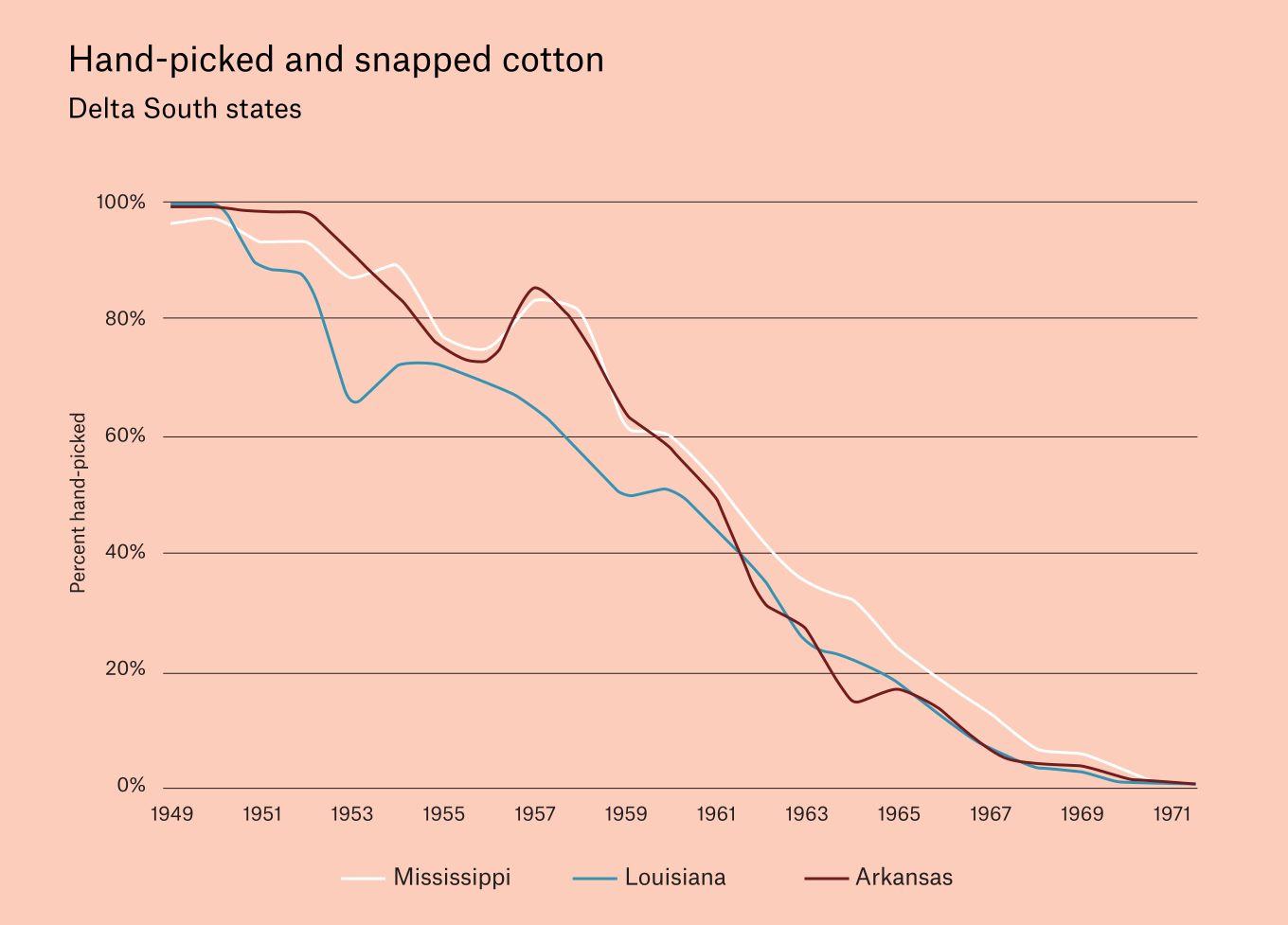
Source: United States Department of Agriculture, Economic Research Service, “Statistics on Cotton and Related Data, 1920–73”
In 1948, before the International Harvester picker hit the market, 100% of the Louisiana cotton harvest was hand-picked. By 1972, the Department of Agriculture estimated the hand-picked share at less than 0.05%. In a quarter-century, a job that had been pivotal to American farming and the whole course of American history was entirely automated away.
But the social calamity that the Rusts predicted their invention would cause, and that their critics in the press deeply feared, did not transpire. There was no mass immiseration of sharecroppers in the Cotton South. Instead, the same economic factors that made the mechanical cotton-picker a success meant that fields it tilled were largely empty by the time it arrived.
First, the AAA greatly incentivized firms to move away from sharecropping arrangements to wage labor. That reduced pickers’ ties to the land and made it significantly easier for them to pack up and go. It also made it easier to consolidate farmland into tracts large enough to justify investment in a mechanical picker.
Second, World War II dramatically changed the labor market for cotton-picking. The drafting of fighting-age men into the military and the emergence of high-wage manufacturing work for the women and non-fighting men who remained meant that wages for cotton-picking skyrocketed. In 1940, the average wage for picking 100 pounds of cotton in Mississippi was 57 cents. In 1941, once the draft and Lend-Lease production of bombs, tanks, and other materiel for the British and Soviets had begun, it nearly doubled to $1.10. From there it kept rising, hitting $2.80 in 1948.
Those desperate wage hikes reflected a stream of former cotton pickers heading to cities, mostly in the North, for higher-wage factory work — and the start of the second Great Migration of black Americans northward.
These wage hikes made mechanized cotton picking much more economically viable. Analysts from International Harvester estimated that the break-even point between human and machine-harvested cotton was about $2.50 per 100 pounds. That is, it was better for planters to use human pickers if they could get them for under $2.50 per hundredweight; but above that, machines started to look more attractive.
Considering that the going hand-picking rate was barely 60 cents in the late 1930s, it is natural to wonder if the Rusts would have succeeded even if they had been able to produce a mass-produced model then. Their machine was fine, but it could not compete with cheap Southern labor. Once Southern labor was no longer cheap, though, mechanization became very attractive indeed. And because it was no longer cheap due to a mass exodus from the farming sector and migration northward, there were far fewer people left for their invention to displace.
If the Rusts’ more grandiose plans for social improvement failed to materialize, then, at least the calamity those plans were meant to ameliorate failed to materialize as well.
Of cotton and data centers
At this point, the more fervently AGI-pilled readers may be dismissing the relevance of the Rusts’ story to AI altogether. Mechanical cotton pickers wound up — like horseless carriages or personal computers or most other automation tools — leading workers to switch careers, rather than fundamentally upending the economic system. This time will be different. Comparing AI to past automations is a category error.
Maybe so. But I still think there are some things those of us living amid the AI boom might be able to learn from the Rusts’ saga.
The most important lesson is that a company that loses can’t achieve anything at all. The Rust Foundation and the brothers’ visions of directing the profits from their invention back to the people it displaced never came true, not due to a lack of sincerity on their part but because the Rust Company fell behind its competitors, did not raise enough money, and failed. That let International Harvester and John Deere, with no such humanitarian aspirations, catch up. That idealistic businesses have to be sufficiently competitive and earn sufficient market share before they can hope to use their market power to help anybody, is sound, and amply illustrated by the Rusts.
That’s a lesson that Anthropic has taken to heart, justifying less-stringent risk-mitigation policies by insisting that if the lab goes too far on its own, “we wouldn’t be competitive and whatever practices we implemented would not be well-suited to adoption by other AI developers.”
But this dynamic also sharply limits how much good firms like Anthropic can do. If for-profit companies can only wield market power for good when they’re winning commercially, and if obeying ethical standards imposes heavy costs that meaningfully harm their odds of commercial success, then there will always be a hard tradeoff between their business mission and their avowed social mission. Navigating that tradeoff will probably require sacrificing those restrictive standards.
That implies quite strongly that for-profit businesses cannot achieve much counterfactual social impact. They can make money, certainly. Even John Rust made money after his bankruptcy by licensing off his designs. But he wasn’t able to use his business and his engineering prowess to make the world more just.
The Rusts are a reminder that there is a thin line between thoughtful, socially-minded planning and outright hubris. Today’s AI companies are trying to use corporate governance to ensure the political, social, and economic transition they foresee goes well. I genuinely hope they succeed. But the Rusts did the same thing, and, ultimately, it just didn’t work.